Saudi Arabia Traffic Fines and Violations: Complete Guide
Learn about Saudi Arabia traffic violations and fines, including speeding penalties, red-light fines, mobile phone violations, seatbelt rules, demerit points.
Driving in Saudi Arabia comes with clear rules — and real consequences for breaking them. The General Traffic Department (Muroor), operating under the Ministry of Interior, enforces a structured system of eight violation categories, each carrying financial penalties and, in many cases, demerit points against your driving record.
Overview: The 8 Violation Categories
Saudi traffic law groups all violations into eight tables, from the most minor infractions to the most dangerous.
| Category | Violation Type | Fine Range | Demerit Points |
|---|
Category 1 (SAR 100–150)
These are the least serious violations on Saudi roads, but they still carry a fine — and unpaid fines can block your Iqama renewal.
- Driving in areas where vehicles are not permitted (e.g. market zones)
- Leaving your vehicle unlocked and running after stepping out
- Driving without valid vehicle insurance (Tamin)
- Parking in places not designated for parking
- Pedestrians crossing roads from places other than designated crossings
- Pedestrians not following their own crossing signals
- Not giving priority to pedestrians at a designated pedestrian crossing
Category 2 (SAR 150–300)
This table covers safety essentials — seatbelts, signals, lights, and documentation. Seatbelt violations also carry 2 demerit points.
- Not using the turn signal when turning, overtaking, or changing lanes
- Not wearing a seatbelt (driver or any passenger) — 2 demerit points
- Reversing on a highway for more than 20 metres
- Attaching to or being pulled by another vehicle (cyclists, motorcycle riders)
- Violating rules for using convergence/dipped headlights
- Not carrying your driving licence while driving
- Misuse of the vehicle horn
- Failure to submit vehicle for periodic technical inspection (Fahas)
- Violation of traffic regulations on the road
- Placing barriers inside or outside the vehicle that obstruct the driver’s vision
- Not maintaining sufficient following distance from the vehicle ahead
- Accelerating so hard that the tyres make a loud sound (wheel spin)
- Gathering at the scene of an accident (obstructing traffic)
- Overtaking vehicles at traffic lights or security checkpoints using the shoulder or turning lane
- Missing regulatory requirements for a trailer
Category 3 (SAR 300–500)
These violations involve driver behaviour that creates hazards or disturbances on the road.
- Failure to take necessary precautions when stopping in an emergency on a public road
- Throwing objects outside the vehicle while driving
- Slowing down in a way that obstructs the flow of traffic
- Distracted driving — not focusing on the road while the vehicle is in motion
- Applying brakes suddenly and without reason
- Not complying with traffic regulations at road intersections
- Failing to stay within designated lane markings
- Making noise using devices inside the vehicle, or any behaviour contrary to public morals while driving
- Driving with an expired driving licence
- Failure to use child safety seats
- Leaving a vehicle on a sloped road without taking the necessary precautions
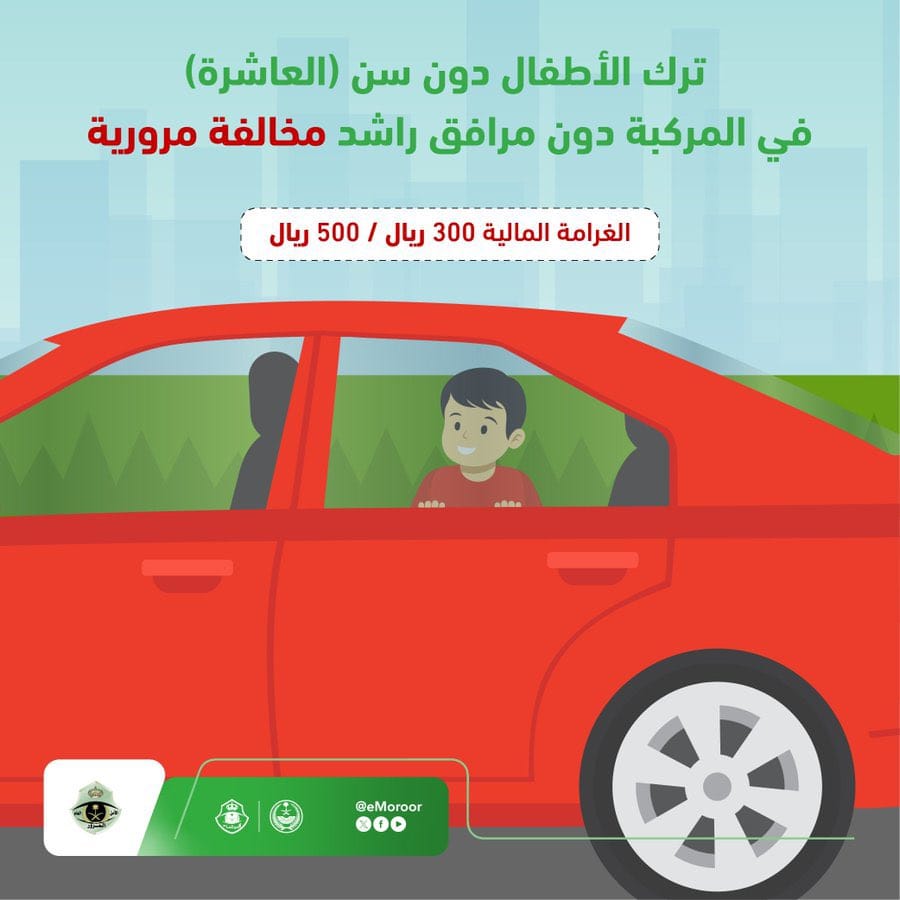
- Leaving children under the age of 10 in a vehicle without an accompanying adult
Category 4 (SAR 500–900)
This is one of the most practically relevant categories for everyday drivers — it covers mobile phone use, STOP signs, roundabout priority, and window tinting.
- Chasing or following emergency vehicles with sirens active
- Driving on the road with vehicles designed for acquisition (towing vehicles)
- Not stopping completely at a STOP sign — 6 demerit points
- Not stopping at a Give Way sign when vehicles on the priority road are passing
- Not giving right-of-way to vehicles from the right at equal-priority intersections (no signals present)
- Not giving right-of-way to vehicles already on a highway
- Not obeying hand signals of a traffic officer (overrides all traffic lights) — 8 demerit points
- Not giving priority to vehicles already inside a roundabout — 6 demerit points
- Driving inside tunnels without headlights on
- Overloading light transport vehicles beyond permissible dimensions
- Unnecessary use of emergency sirens
- Using a handheld mobile phone while driving — 2 demerit points
- Parking in spaces reserved for people with special needs
- Placing unapproved writing, stickers, or statements on the vehicle body
- Driving a vehicle that pollutes the environment on public roads
- Tinted windows that do not comply with limits set by the competent authority
- Using a vehicle for a purpose other than its licensed use
- Not covering or securing cargo on a transport vehicle — 4 demerit points
Category 5 (SAR 1,000–2,000)
These violations carry substantial fines and multiple demerit points. Several also involve vehicle impoundment.
- Trucks and heavy vehicles entering or leaving cities outside permitted hours
- Driving with a licence that does not match the vehicle type or size
- Stopping on railway tracks — 6 demerit points
- Carrying more passengers than the number specified in the driving licence
- Refusing to present driving or vehicle documents to authorised persons
- Driving with unclear or damaged licence plates
- Driving a vehicle with no front number plate
- Failure to complete procedures for modifying the area of use of a vehicle
- Not taking out a vehicle intended for export within the specified period
- Not wearing a helmet while riding a motorcycle — 2 demerit points
- Driving a vehicle before obtaining a licence, or while the licence is suspended — 4 demerit points
- Leaving objects on public roads that endanger public safety
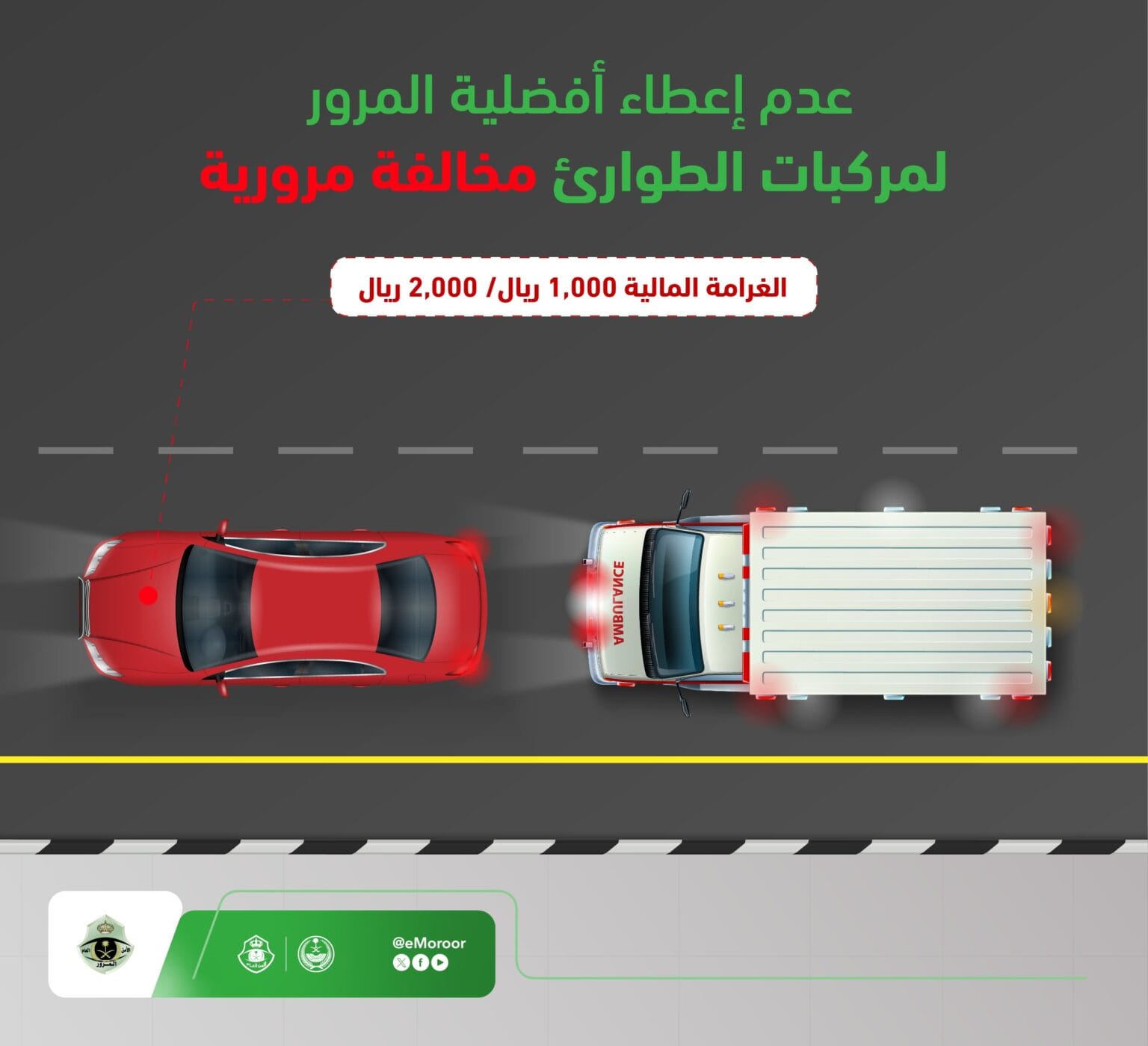
- Not giving way to official or emergency procession vehicles
- Driving on road shoulders, pavements, or restricted paths — 4 demerit points
- Passengers getting on or off a vehicle while it is in motion
- Pedestrians crossing highways (expressways)
- Overtaking in prohibited areas such as bends and hills — 6 demerit points
- Missing side lighting, reflectors, or screens on trucks and trailers
- Not using required lights at night or in poor visibility
- Gathering at drifting sites
- Overloading heavy transport vehicles beyond permissible dimensions
- Unauthorised modifications or additions to vehicle body or structure — 4 demerit points
- Driving a vehicle without required equipment such as functioning brakes or lights — 8 demerit points
- Using number plates not issued by the competent authority
Category 6 (SAR 3,000–6,000)
These are serious violations that Saher cameras are specifically configured to catch. Running a red light alone can cost you SAR 6,000.
- Running a red light — 12 demerit points
- Overtaking a school bus stopped to load or unload students — 4 demerit points
- Tampering with road signs, reflectors, or traffic-regulating markers
- Failing to stop at a security checkpoint or for a security patrol — where a sign or directive requires a stop
- Using unauthorised devices in the vehicle, or displaying slogans contrary to public morals
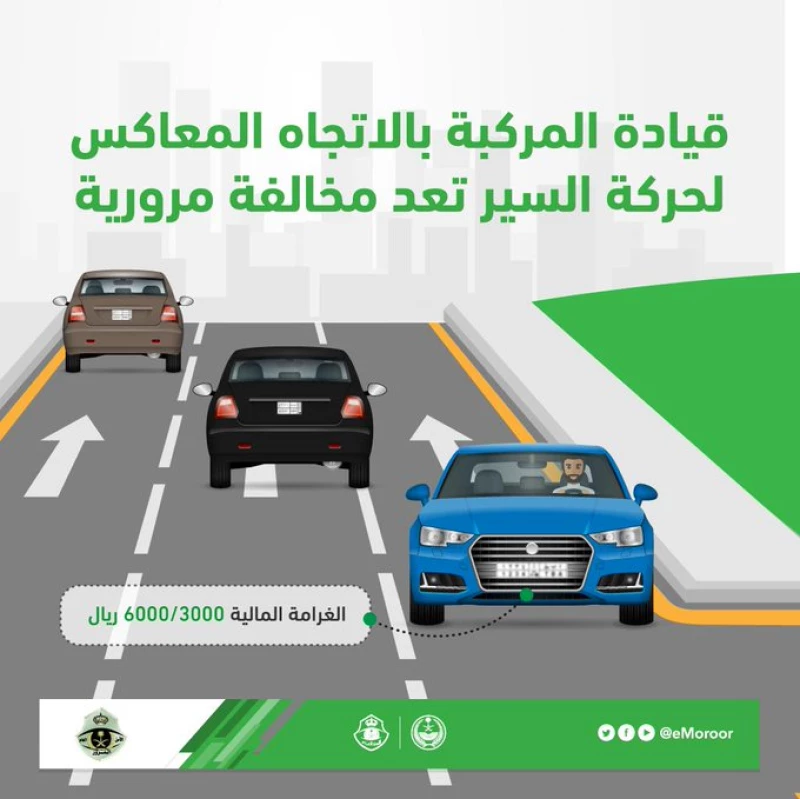
- Driving the wrong way against the flow of traffic — 12 demerit points
- Reckless weaving between vehicles at speed — 8 demerit points
- Participating in a vehicle race on public roads, or driving in a convoy without a prior permit
- Trucks and heavy equipment not keeping to the right lane on multi-lane roads
- Animal owners not keeping animals away from approved road areas
- Installing equipment in a vehicle that resembles those used in official or emergency vehicles
- Driving public works vehicles on roads before taking necessary safety measures (including missing rear reflective strips)
- Driving without a rear number plate, or without any plates
- Defacing or obscuring vehicle number plates
Category 7 (SAR 5,000–10,000)
These violations represent some of the most dangerous acts on Saudi roads. Driving under the influence results in 24 demerit points — an automatic licence suspension.
- Driving under the influence of intoxicants, narcotics, or related drugs — 24 demerit points
- Carrying out road works without coordinating with the relevant authority
- Animal owners allowing animals to cross roads from non-designated locations, or without coordination with authorities
- Using number plates that do not belong to the vehicle
- Defacing the vehicle chassis number or attempting to destroy it
Category 8: Speeding Violations
Speeding fines are tiered based on how far over the limit you are, and vary depending on whether the road’s speed limit is 120 km/h or 140 km/h.
Roads with a Speed Limit of 120 km/h or Below
| Speed Exceeded By | Min Fine (SAR) | Max Fine (SAR) |
|---|
Highways with a Speed Limit of 140 km/h
| Speed Exceeded By | Min Fine (SAR) | Max Fine (SAR) |
|---|
Drifting (Tafheet)
Drifting on public roads is treated as one of the gravest traffic offences in Saudi Arabia. The penalties escalate sharply with each repeat offence, and all drifting convictions carry 24 demerit points — meaning an automatic licence suspension on top of the financial penalty.
- First offence: SAR 20,000 fine + vehicle impounded for 15 days. Imprisonment is considered by the authorities.
- Second offence: SAR 40,000 fine + vehicle impounded for one month. Imprisonment must be considered.
- Third offence: SAR 60,000 fine + vehicle permanently confiscated.
- Rented or stolen vehicles: Cannot be confiscated, but a fine equal to the vehicle’s value must be paid.
The Demerit Points System
Saudi Arabia uses a demerit points system alongside financial fines. Points are allocated based on the danger a violation poses to public safety. A driver who accumulates 24 points will have their licence withdrawn — regardless of how many violations made up those points.
Key rules:
- Points are added to your driving record with each violation.
- If one full Hijri year passes without any new violations, points from earlier violations are automatically cleared from your record.
- Accumulating 24 points at any time triggers licence withdrawal.
Full Demerit Points Table
| # | Violation | Fine Table | Points |
|---|
Licence Withdrawal and Revocation
When a driver reaches 24 demerit points, their licence is withdrawn. The severity of the suspension depends on how many times the driver has reached this threshold within one Hijri year.
| Offence Count (within one Hijri year) | Penalty |
|---|
Permanent Revocation
If a driver whose licence is under a revocation period is caught driving, they are treated as an unlicensed driver and referred to the competent court for doubled penalties. They may also be directed to attend a 15-day rehabilitation programme at a driving school.
If a licence is permanently revoked, a new application can only be submitted one year after the revocation date — provided the driver completes a one-month rehabilitation programme at a driving school and passes both the theory and practical driving tests.
More in this guide
- Absher Travel: Step-by-Step Guide for Saudi-Bahrain Border Crossing — Step-by-step guide for Saudi residents
- ALFURSAN Program: Everything You Need To Know — Discover key information about ALFURSAN, the frequent flyer program of SAUDIA, including membership tiers, earning miles, redeeming rewards..
- Bahrain Travel Guide for Saudi Expat Residents via Causeway — Learn the essential steps and requirements for Saudi Iqama holders traveling to Bahrain via the King Fahd Causeway, including visas, fees, more
- Buying a Used Car in Saudi Arabia: Complete Guide for Expatriates (2026) — Learn requirements, costs, inspection tips, financing, Absher transfer process, and more
- How to Check Saudi Driving License Status Online — Public Query Driving License
- How to Check Vehicle Insurance Validity in Saudi Arabia — Easily check your vehicle insurance validity in Saudi Arabia using Absher with this quick step-by-step guide